
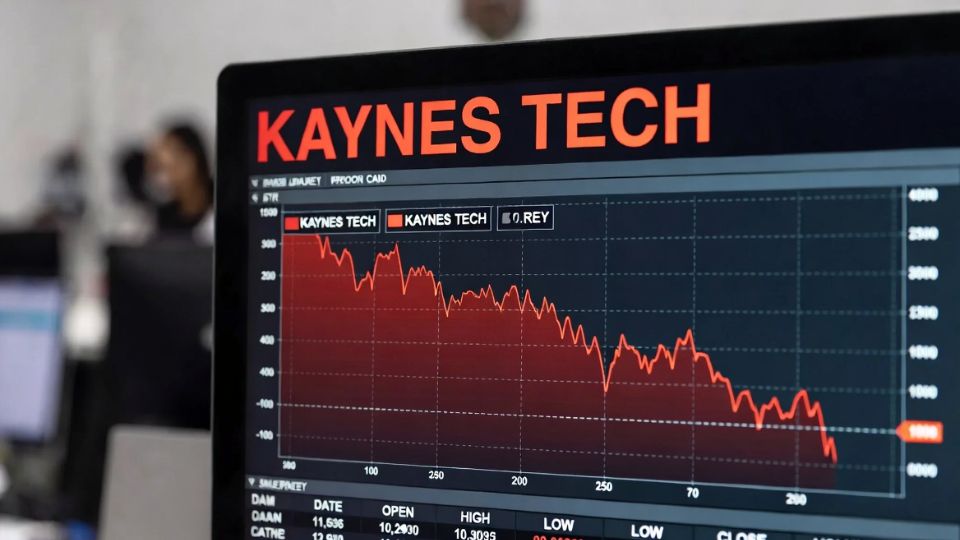
In today’s fast-paced stock market, many investors are closely watching Kaynes Technology share price. As of late December 2025, the stock has experienced significant volatility, dropping sharply amid concerns over cash flows and disclosures but showing signs of recovery with new partnerships. This guide provides a clear overview of the current Kaynes Technology share price, key factors influencing it, and insights to help you make informed decisions.
Kaynes Technology India Ltd (NSE: KAYNES) is a leading player in India’s electronics manufacturing services (EMS) sector. Understanding its share price movements can reveal opportunities in a growing industry supported by government initiatives like “Make in India.”
Understanding Kaynes Technology: Company Overview
Kaynes Technology India Ltd is an end-to-end IoT-enabled integrated electronics manufacturer. Founded in 1988 and headquartered in Mysore, the company offers services from conceptual design and process engineering to full-scale manufacturing and lifecycle support.
Key sectors served include:
- Automotive
- Aerospace and defense
- Medical
- Railways
- Industrial
- IoT and IT
The company has expanded aggressively, including into semiconductors through its subsidiary Kaynes Semicon. In December 2025, Kaynes Semicon announced partnerships with Japan’s AOI Electronics for advanced packaging technology and Mitsui & Co. for critical material supply. These moves strengthen its position in India’s budding semiconductor ecosystem.
Promoters hold about 53.5% of the company, with institutional investors (FIIs and DIIs) making up the rest. No dividends are paid yet, as profits are reinvested for growth.
Current Kaynes Technology Share Price and Recent Performance
As of December 23, 2025, the Kaynes Technology share price hovers around ₹4,200–₹4,300 on the NSE and BSE. The stock has been volatile this month:
- It hit a 52-week high of ₹7,825 earlier in 2025.
- It touched a low near ₹3,714 amid a sharp correction.
- Year-to-date performance shows a decline of over 40%, reflecting broader EMS sector pressures.
Despite the drop, recent sessions have seen rebounds, with gains of 5–6% on positive brokerage notes and institutional buying. For instance, Smallcap World Fund picked up shares in mid-December.
Short paragraphs help highlight: The stock trades at a high P/E ratio (around 95–100), indicating growth expectations but also valuation risks.
Factors Influencing Kaynes Technology Share Price in 2025
Several elements drive the Kaynes Technology share price:
Strong Growth Fundamentals
Revenue guidance targets ₹4,200–4,500 crore for FY25, with ambitions of $1 billion by FY28. Order books remain robust at over ₹8,000 crore.
Recent Challenges
Concerns over working capital, acquisition accounting, and cash flows led to a 30–50% drop in December. Brokerages like Kotak and Elara cut targets, though many retain “Buy” ratings citing long-term potential.
Positive Developments
New semiconductor tie-ups and credit rating reaffirmations (e.g., CRISIL A) provide support. Analysts highlight diversification away from smart meters (now ~25% of revenue).
Market sentiment in the EMS space, including peers like Dixon Technologies, has been mixed due to global demand worries.
Kaynes Technology vs. Peers: Comparison Table
Here’s a quick comparison of Kaynes Technology with key peers in the EMS and electronics sector (data approximate as of December 2025):
| Company | Market Cap (₹ Cr) | P/E Ratio | Revenue Growth (YoY) | 1-Year Return | Key Strength |
|---|---|---|---|---|---|
| Kaynes Technology | ~28,000 | ~95 | ~50% | -43% | Semiconductor expansion |
| Dixon Technologies | ~75,000 | ~120 | ~60% | -20% | Consumer electronics focus |
| Syrma SGS Technology | ~15,000 | ~80 | ~40% | -30% | Automotive expertise |
| Amber Enterprises | ~20,000 | ~90 | ~35% | -15% | AC and components |
| CG Power | ~50,000 | ~100 | ~45% | +10% | Industrial and power |
Kaynes stands out for its defense and aerospace exposure but trades at a premium due to semiconductor ambitions.
Pros and Cons of Investing in Kaynes Technology Shares
Pros
- High growth potential: Benefiting from India’s ESDM push and PLI schemes.
- Diversified portfolio: Exposure to high-margin sectors like defense and medical.
- Strong order pipeline: Supports multi-year revenue visibility.
- Strategic partnerships: Recent semiconductor deals enhance capabilities.
Cons
- High valuations: Elevated P/E makes it sensitive to earnings misses.
- Volatility: Recent sharp corrections highlight risk.
- Cash flow concerns: Working capital intensity in expansion phase.
- No dividends: Growth-focused, no payouts yet.
Overall, it’s suited for long-term investors comfortable with volatility.
Analyst Views and Price Targets
Analysts remain divided but largely positive on the structural story. Average target price sits around ₹6,000–₹6,500, implying 50%+ upside from current levels.
- Bullish views (e.g., Motilal Oswal: ₹7,300) emphasize execution in semiconductors.
- Cautious ones (e.g., some “Reduce” ratings) flag rich valuations and near-term cash pressures.
Consensus: About 50% “Buy” ratings.
Conclusion
The Kaynes Technology share price in late 2025 reflects a mix of challenges and opportunities. While short-term volatility persists due to sector de-rating and company-specific concerns, the long-term outlook remains promising driven by India’s electronics and semiconductor boom.
For investors, Kaynes represents a high-growth bet in a strategic industry. Always conduct your own research or consult a financial advisor before investing.
FAQ
1. What is the current Kaynes Technology share price?
As of December 23, 2025, the share price is approximately ₹4,200–₹4,300. Check live quotes on NSE/BSE for real-time updates, as prices fluctuate.
2. Is Kaynes Technology a good investment for 2026?
It could be for growth-oriented investors, given expansion plans and analyst upside targets. However, high valuations and volatility make it risky—consider your risk tolerance.
3. Why did Kaynes Technology share price drop in December 2025?
The decline stemmed from brokerage target cuts amid concerns over cash flows, disclosures, and broader EMS sector weakness. Recent partnerships have aided some recovery.