
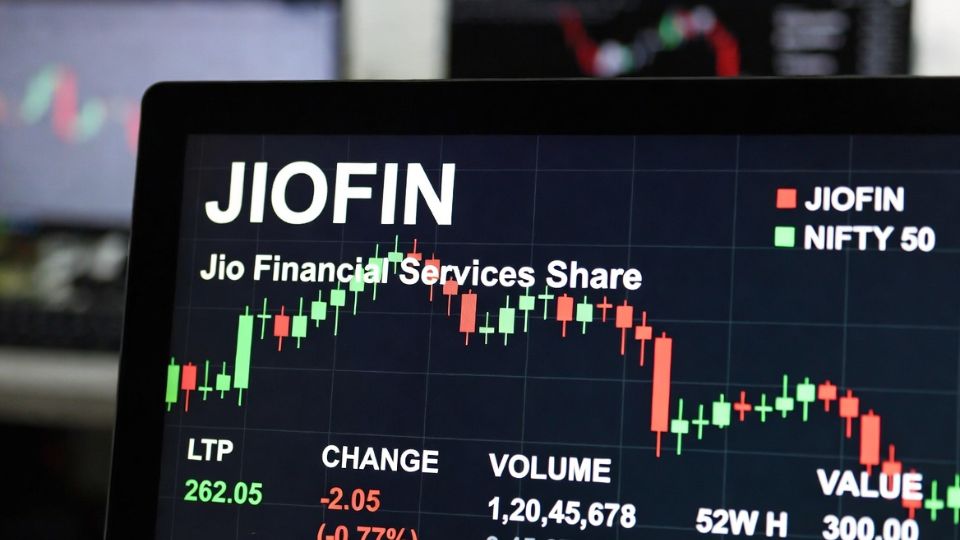
The Indian financial services sector is booming, driven by digital innovation and increasing financial inclusion. Many investors are closely watching Jio Financial Services share (NSE: JIOFIN), the demerged entity from Reliance Industries. As of December 23, 2025, the share price hovers around ₹299, with a market capitalization exceeding ₹1,89,000 crore.
This makes it a prominent player in the NBFC and fintech space. If you’re wondering whether Jio Financial Services share is a good addition to your portfolio, this guide breaks down its current performance, business model, and future potential in simple terms.
What is Jio Financial Services?
Jio Financial Services Limited (JFSL) is a core investment company focused on building a full-stack digital financial services platform. Demerged from Reliance Industries in 2023, it leverages the massive Jio ecosystem to offer affordable and accessible financial products.
The company operates through subsidiaries like Jio Finance Limited for lending, Jio Insurance Broking for insurance distribution, and Jio Payments Bank for banking services. Key highlights include:
- A strong net worth of over ₹1,39,000 crore.
- Partnerships, such as a 50:50 joint venture with BlackRock for asset management.
- The JioFinance app, which integrates payments, loans, insurance, and investments.
JFSL aims to serve underserved segments using data analytics and digital tools, making finance simpler for millions of Indians.
Current Jio Financial Services Share Price and Performance
As of December 23, 2025, the Jio Financial Services share price stands at approximately ₹298-299, showing slight fluctuations in recent trading sessions.
The stock has traded in a range of ₹297-300 this week, with moderate volume.
Key Performance Metrics:
- 52-Week High/Low: ₹338.60 / ₹198.65
- Year-to-Date Return: Down about 2-3% in 2025, reflecting market volatility.
- Recent Quarterly Results: Consolidated net sales grew 41% YoY to ₹981 crore in Q2 FY26, with net profit stable around ₹695 crore.
- P/E Ratio: Around 117, indicating growth expectations but also premium valuation.
The stock has shown resilience amid broader market corrections, supported by ongoing expansions like investments in Jio BlackRock AMC and leadership appointments.
Factors Driving Jio Financial Services Share Price
Several elements influence the share’s movement:
Positive Drivers:
- Digital Growth: The JioFinance app and payments bank are scaling rapidly, tapping into Jio’s 400+ million telecom users.
- Strategic Partnerships: Ties with BlackRock and full ownership of Jio Payments Bank position it strongly in wealth management and payments.
- Strong Balance Sheet: Almost debt-free with high liquidity, enabling aggressive expansion.
Challenges:
- Intense competition in fintech and lending.
- Regulatory hurdles in financial services.
- High valuations that leave little room for error.
Analysts remain cautiously optimistic, with some targets around ₹318-343, citing long-term potential in India’s growing economy.
Jio Financial Services vs. Competitors: A Comparison Table
To understand where Jio Financial stands, here’s a comparison with key peers in the NBFC and fintech space (data approximate as of late 2025):
| Company | Market Cap (₹ Cr) | P/E Ratio | 1-Year Return | Key Focus Areas | Debt Level |
|---|---|---|---|---|---|
| Jio Financial Services | 1,89,800 | 117 | -2% | Digital lending, payments, insurance, asset mgmt | Low (Almost debt-free) |
| Bajaj Finance | ~4,50,000 | 32 | +15% | Consumer finance, EMI cards | Moderate |
| Muthoot Finance | ~70,000 | 16 | +20% | Gold loans | High |
| Shriram Finance | ~1,00,000 | 14 | +25% | Vehicle & small business loans | Moderate |
| Paytm (One97 Communications) | ~40,000 | N/A (Loss-making) | -10% | Digital payments, fintech | Low |
Jio Financial trades at a premium due to its growth story and Reliance backing, while peers offer value with lower P/E and higher returns.
Pros and Cons of Investing in Jio Financial Services Share
Pros:
- Massive Ecosystem Advantage: Access to Jio’s user base for quick customer acquisition.
- Diversified Offerings: From loans and insurance to mutual funds via BlackRock JV.
- Digital-First Approach: Low-cost operations and scalability in a digitizing India.
- Strong Financials: High net worth and minimal debt provide stability.
Cons:
- High Valuation: Elevated P/E may lead to volatility if growth slows.
- Early-Stage Risks: Still building core businesses; profits heavily depend on execution.
- Competition: Faces tough rivals like Bajaj Finance, PhonePe, and Google Pay.
- Regulatory Uncertainty: Changes in NBFC or fintech rules could impact operations.
Overall, it’s suited for growth-oriented investors with a long-term horizon.
Future Outlook for Jio Financial Services Share
Looking ahead, Jio Financial is well-positioned in India’s expanding financial services market, projected to grow significantly with rising digital adoption.
Recent moves like appointing a Group COO and investing in subsidiaries signal aggressive scaling.
While short-term fluctuations are possible, successful execution of its super-app vision and partnerships could drive substantial upside.
Analysts see potential for steady growth if the company captures market share in lending and wealth management.
Conclusion
Jio Financial Services share represents an exciting opportunity in India’s fintech revolution, backed by Reliance’s resources and a clear digital strategy.
With the current price around ₹299 and a focus on innovation, it appeals to investors betting on long-term financial inclusion.
However, its premium valuation demands patience. Diversify your portfolio and consider your risk tolerance before investing.
FAQ
1. What is the latest Jio Financial Services share price?
As of December 23, 2025, the share price is approximately ₹298-299 on NSE/BSE, with minor daily variations.
2. Is Jio Financial Services a good long-term investment?
It has strong growth potential due to its digital platform and ecosystem, but high valuations and competition pose risks. Suitable for patient, growth-focused investors.
3. How does Jio Financial Services make money?
Primarily through interest on loans, fees from payments and insurance broking, investment income, and future revenues from asset management.
(Word count: ~1,550)